
Normal screw-in filters have the disadvantage that they only fit a specific filter thread. Although this problem can be solved with adapter rings, screw-in filters have clear weaknesses compared to plug-in systems, especially when it comes to graduated grey filters: the fixed transition boundary limits creative image composition.
Therefore, I would like to introduce two filter systems that are particularly well suited for this purpose. Many manufacturers now rely on magnetic filter holders, eliminating the need for additional adapter rings. For me personally, however, magnetic solutions are out of the question – I don't want magnets in my camera bag. That's why I'm presenting two filter holders that do not use magnets at all, but each offer different advantages.
Comparison of filter holders from NiSi and Lee
Optical filters play a crucial role in landscape and architectural photography. Whether neutral density (ND) filters, graduated neutral density (GND) filters or polarising filters – they enable creative effects, more precise exposure control and professional image composition that is difficult to achieve with software alone. However, in order to use filters safely and flexibly in front of the lens, high-quality filter holder systems are required. Two of the best-known manufacturers are NiSi and Lee Filters.
NiSi filter holders
NiSi has built up an excellent reputation in recent years and is now considered one of the leading suppliers of modern filter solutions.
- Material & Workmanship: NiSi filter holders are usually made of high-quality aluminium, which makes them lightweight, robust and durable.
- Integrated polarising filters: A special feature of many NiSi holders (e.g. NiSi V7 or V6) is the rotating CPL filter already integrated into the holder. It can be conveniently controlled via a small wheel without touching the attached rectangular filters.
- Compatibility: The systems are designed for common filter sizes (100 mm, 150 mm, 75 mm) and thus cover both ultra-wide-angle lenses and standard optics.
- Operation: Thanks to precise guide rails, filters can be easily inserted and securely fixed in place, enabling scratch-free working.
Advantages of NiSi: Modern design, integrated polarising filter, excellent colour neutrality.

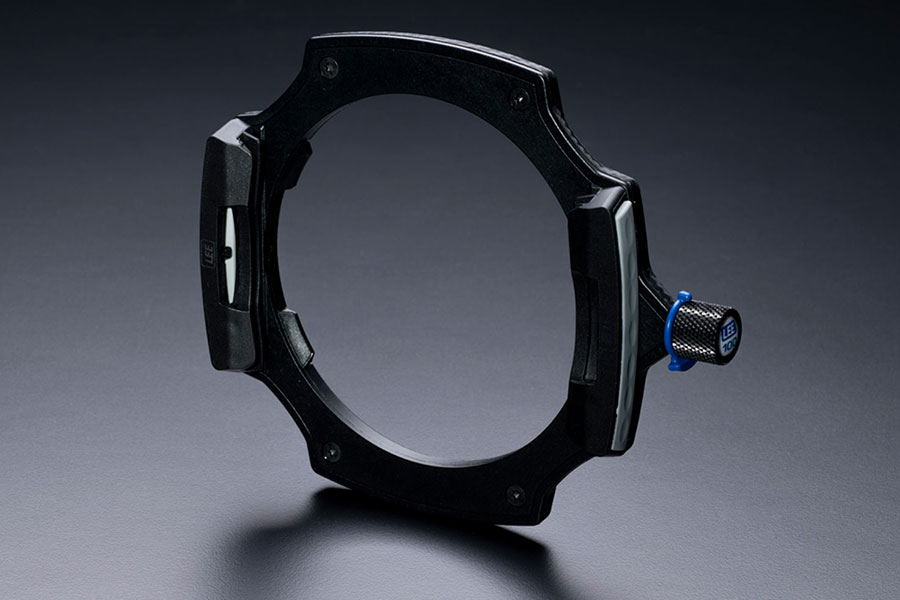
Lee Filter Holders
Lee Filters is one of the most traditional manufacturers of filter holders and has long set the standard in professional photography.
- Material & Workmanship: Lee also relies on high-quality materials, with the holders being a mixture of metal and plastic elements.
- Modularity: The Lee 100 System, which can be flexibly adapted, is particularly well known. Adapter rings allow different lens diameters to be used.
- Filter variety: Lee offers a very wide selection of graduated filters with different degrees of hardness and density – an advantage for photographers who need maximum flexibility.
- Polarising filters: Unlike NiSi, Lee's polarising filters are usually screwed on at the front and not integrated into the holder. This is less convenient, but has proven itself over time.
- Compendium: Another unique feature is the optional Lee-Compendium. It replaces a lens hood and helps to effectively reduce stray light and reflections – particularly useful in backlight situations or when using multiple filters at the same time.
Advantages of Lee: Extremely large selection of filters, high compatibility, many years of experience, optional compendium.

NiSi vs. Lee – Which system is better suited?
- Comfort & innovation: NiSi scores with well-thought-out details such as the integrated CPL filter and very user-friendly handling.
- Filter selection: Lee offers what is probably the largest range of ND and GND filters, while NiSi stands out with its very high colour fidelity and modern coatings.
- Price: Both systems are in the professional segment, but NiSi often offers better value for money.
- Area of application: Landscape photographers who value quick and convenient handling often tend to choose NiSi. Photographers who need a huge selection of special filters or want to use a compendium in addition are very well served by Lee.
Conclusion
Both NiSi and Lee offer first-class filter holder systems that have proven themselves in professional use.
- NiSi impresses with modern features, high colour neutrality and ease of use.
- Lee remains a top choice for photographers who value a wide variety of filters, modular expandability and the option of a compendium.
The choice ultimately depends on personal priorities: convenience and innovation (NiSi) or maximum filter selection and flexibility with a compendium (Lee).


